
The July 24th 2025 voice outage at EE UK was reported as:
“EE, BT and Vodafone are still down for many – here’s what we know about the outage“
The Q-Performance for Voice monitoring schedules calls periodically to and from several operators to test a variety of routes, and can include port outs and port ins.
When multiple sites fail simultaneously and consecutively this is a strong indication of a network outage. Therefore, Q-Performance can raise alarms for failures that may exist externally to any individual core network.
Here we see that calls into EE started failing from 11:04 and the next successful call was then in the North at 14:44:

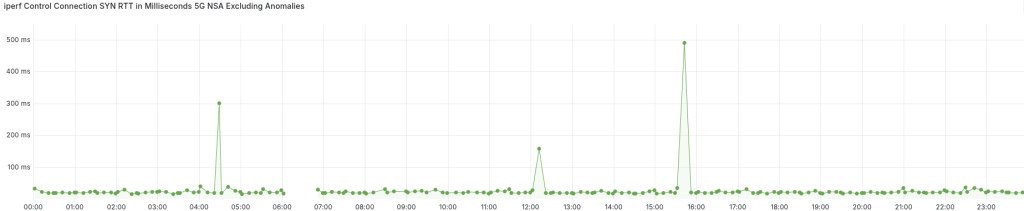
Data was largely unaffected during the voice outage according to Q-Performance Bureau which is based in London, though there was a consecutive block of failed EE iperf tests earlier on between 6am and 7am. Notice that there were also EE voice issues above specifically in London at 6:04 and 7:04.
Here we can see the missing TCP SYNs for EE as the initial connections failed between 6 and 7am:
Whereas the news article is highly speculative as to what extent other networks were affected by the voice outage, Q-Performance can reveal the real time reality objectively. This helps get to the core issues much more quickly as speculative information can be discounted.
There were two explanations from Vodafone for issues affecting their customers:
- I’ve just heard back from a Vodafone spokesperson who’s simply stated that “there is no problem with the Vodafone network”. That doesn’t necessarily mean that Vodafone customers aren’t experiencing any issues today, but it appears that these could simply be the knock-on effect of contacting those on EE or BT landlines.
- A Vodafone spokesperson told me: “Due to the ongoing EE network issue, and the way number porting works across networks, customers who have ported from EE to Vodafone or Three may experience issues too”.
Therefore, it appears that Vodafone or Three customers that are port outs from EE were also affected by EE’s outage. However, Vodafone itself wasn’t down as the title of the news article states.
Q-Performance for Voice monitors EE ports outs for a different operator, which wasn’t affected either for port outs or port ins. This highlights the complexity of this type of outage and why it is invaluable to test a lot of routes using automation. During an outage the data can be used in near real time to zoom in on where the issues are and discard the noise.
The news article also reported that:
Separately, Richie Harrison (Ops Manager for the IT service provider Koris365) told me yesterday that the “biggest impact to our customers has been the call routing through Gamma systems that rely on the affected carriers, which have degraded or failed entirely”. Some of those customers include Blue-Light services and hospitals.
And the following day:
Yesterday, we also saw the likes of South Western Ambulance and the Devon and Somerset Fire and Rescue Service post messages on X stating that the network issues were affecting 999 calls, although these have apparently since been resolved.
EE and BT told me again today that customers could and should use 999 as normal, so at least those issues seem to be sorted – but the impact of this extended outage continues for many.
So some 999 calls were affected. Were 999 calls for port outs or port ins also affected?
Q-Performance supports 999 call monitoring on Android using the separate emergency dialer.
Get in touch today and we can send you a demo video and show you the system on a call:


 Q-Performance Bureau
Leave a comment